Media Trends for 2027: Key Insights from DMEXCO 2026
Retail media is breaking out of its silo, AI is taking on more and more tasks, and even the value of an impression is now up for debate. At DMEXCO 2026, the industry discussed which media trends will shape the coming year.
Media in 2027: Optimize what matters
More data, more channels, more automation – the range of possibilities in the media business continues to grow. Making the right choices is therefore becoming increasingly important. Which channels align with the campaign’s goal? Where can a campaign engage with people in the right context? And what impact can ultimately be demonstrated?
Our preview of the World of Media already illustrated just how blurred the boundaries have become between retail media, DOOH, CTV, audio, the creator economy, and traditional media planning. The sessions on the Media Stage at DMEXCO 2026 explained what this means in concrete terms. AI is transforming processes and purchasing decisions. Retail media is expanding its area of activity. At the same time, greater focus is being placed on attention and quality.
The key takeaways for your next media plan
#1 Retail media: Time to break out of the silo!
Retail media now encompasses much more than just sponsored products in online stores. Retailers are making on-site, off-site, and in-store channels much more closely aligned. Their first-party data is helping brands target relevant audiences and link media to actual purchasing behavior. Corinna Hohenleitner (BVDW), Annika Berthold (L’Oréal), Markus Vones (OTTO Advertising), Patricia Grundmann (OBI Advertising), and Annette Calandrini (Ferrero) discussed this topic in the session “Retail & Commerce Media Today: Trends, Growth, and the Road Ahead.” According to the panel members, physical touchpoints in particular are currently growing in importance again. At the same time, brands want to make more frequent use of retail data for off-site campaigns.
As the number of retail media networks grows, so does complexity. Anyone looking to plan campaigns across multiple networks needs common standards for formats and measurement. Pricing and technology must also be made more comparable. The panel discussion titled “Global Retail & Commerce Media Playbook: What Europe Can Learn from the Best” turned its attention to other markets. Participants included Clemmentijn Treinen (Microsoft Advertising), Jason Wescott (WPP Media), Colin Lewis (Commerce Media Works), and Martin Hoffmann (flaconi). Their recommendation: Europe should emulate the ambition of more advanced markets but shouldn’t copy their “walled garden” approach. Open standards could benefit the fragmented European market.
Action you can take: Plan retail media beyond the lower funnel. Connect on-site, off-site, and in-store channels, and push for comparable KPIs across networks.
#2 Agentic AI: More time for better ideas
AI is transforming media planning, activation, and measurement. In her session “The Real Job of Agentic AI in DOOH: Buying Back Time for Creativity,” Laure Malergue, CEO and co-founder of Displayce, drew attention to another effect: Agentic AI can free up time for teams to focus on creative work.
The example of DOOH illustrates where the challenges lie. Digital out-of-home advertising is able to combine context and data with programmatic delivery. Nevertheless, in practice, the same ad creatives often run all day long on different screens. Complex campaigns are still very time-consuming. Agentic AI can relieve teams of some of this work. For example, agents can help select suitable screens and audiences or tailor various messages to suit different situations. This frees up capacity for human marketers to focus on tasks that really benefit from their ideas.
Action you can take: Don’t use AI just to speed up existing processes. Figure out which creative ideas it can help you implement on a larger scale for the first time.
#3 From click to conversation: Agentic commerce is changing visibility
One of the most important media trends for 2027 is that AI is shifting the moment when purchasing decisions are made. In “The AI Revolution in Retail Media: Shaping the Next Era of Consumer Engagement and Commerce,” Georg Schmitz (Schwarz Digits), Alexander Steenbakkers-Noffke (BVDW), Roxanne van Duijn (Google), and Luise Weiss (idealo) discussed AI assistants and shopping agents. These systems search for products, compare them, and can draw up a shortlist for consumers.
The trend is leading to the creation of a new form of shelf space. Although brands must remain visible in search results and on product pages, their position in an AI’s relevant set will also matter in the future. This presents the industry with new challenges when it comes to measurement. For example, an AI might recommend a product on Tuesday that a person then purchases directly from an online store two days later. Conventional attribution models have difficulty tracking paths like this. The panel acknowledged that the industry still needs to develop suitable solutions.
Action you can take: Consider how you can maintain your brand’s visibility in AI-based purchasing decisions. You’ll also need measurement models that can track customer journeys without relying on standard clicks.
#4 Attention: “Time well spent” rather than just “time spent”
Reach alone says little about people’s perceptions of advertising. Context matters, as does the moment at which a message is received. Jenny Haggard, Global Head of Thought Leadership at Spotify, discussed this topic in “The Fan Edit: What Gen Z Are Telling Brands.” One insight she shared from Spotify’s Culture Next Report was that Gen Z increasingly streams music based on “vibe” – in other words, according to their own mood or desired mindset. Listening to podcasts, on the other hand, is turning into a ritual, with users regularly returning to their favorite creators.
For the media industry, this opens up an additional perspective on targeting. Who a campaign reaches isn’t the only thing that matters – the individual’s state of mind when they’re exposed to a message can be equally significant.
Haggard expresses this idea succinctly as “time well spent.” People consciously choose certain content and invest their time in it with a specific intention. Studies referenced in the session suggest that an environment the audience likes and trusts can also boost the effectiveness of advertising.
Action you can take: Shift your focus beyond contact figures and time spent. When planning your campaigns, factor in the times when people are receptive to your messages and the contexts in which you reach them.
#5 Quality is king in an automated media world
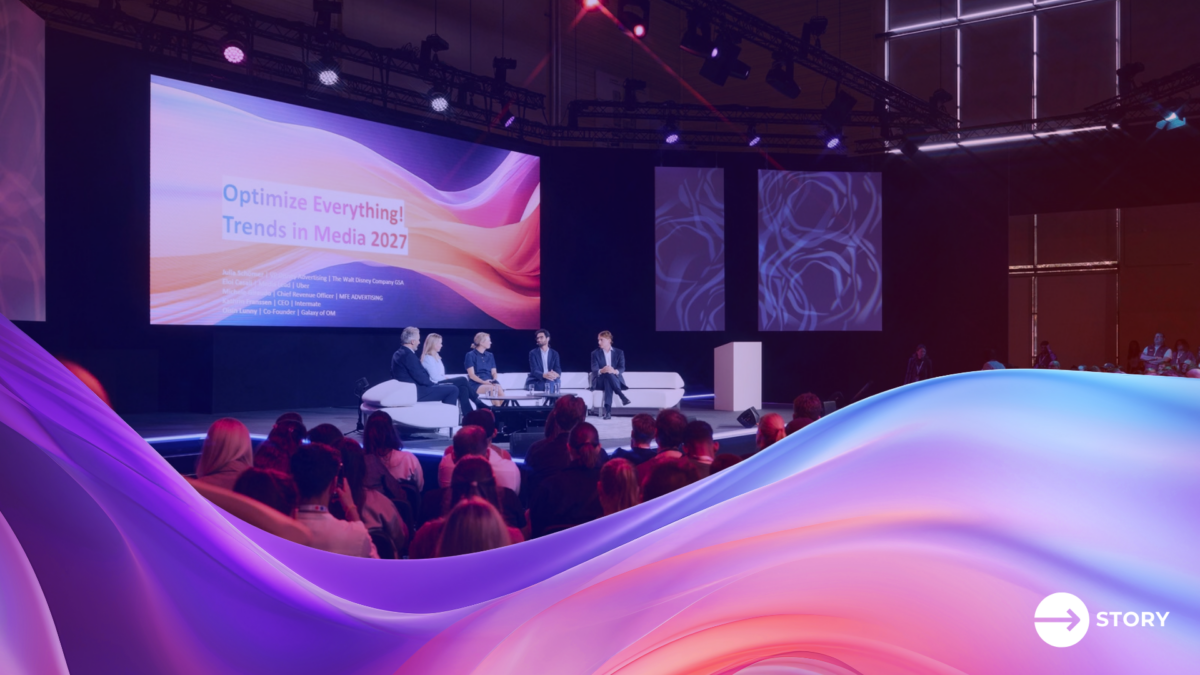
The easier it becomes to produce content using AI, the more important the quality of that content becomes. The panel discussion “Optimize Everything! Trends in Media 2027” explored precisely this issue. Julia Schörner (Disney Advertising), Oliver Hey (Mediaplus), Oisin Lunny (Galaxy of OM), Eloi Casali (Uber), Michele Giraudo (MFE Advertising), and Kathrin Franssen (Intermate) shared their insights on stage.
Among other topics, the panelists spoke about the growing volume of AI-generated content and its implications for brand safety, noting that high-quality advertising environments are becoming increasingly important as a result. Julia Schörner observed that people feel differently about advertising depending on the context in which they encounter it. Especially when it comes to brand building, high-quality advertising environments can help to establish an emotional connection.
Action you can take: Use AI where it lightens your team’s workload. But you’d be wise to keep a close eye on ideas, context, and quality yourself.
The takeaway: Media trends for 2027 – build your media mix around a goal
The boundaries between channels and disciplines are becoming more fluid. Retail media now extends beyond online stores, AI is transforming planning and purchasing decisions, and attention cannot be assessed on the basis of reach alone. All of these developments are making media planning more challenging.
That’s why setting a clear goal is all the more important. After all, new media trends, new channels, new tools, and additional data points don’t automatically make a campaign better. What makes the difference is matching the right combination to the task and measuring the actual impact it achieves. That’s where optimization pays off.
Want to learn more about the latest media trends and additional highlights from DMEXCO 2026? You’ll find a wide range of sessions in the DMEXCO video-on-demand library.

The media and marketing graduate worked for television during his studies and has long felt at home in the world of media. Alex is passionate about topics such as retail media, DOOH, payment, audio and TV.