In-Car Advertising: Is the Dashboard the Next Ad Platform?
The connected car is becoming a medium with banners, offers, and sponsored pins. BMW proved what’s possible today with its Spider-Man campaign. What opportunities does in-car advertising open up – and how does it fit into the DOOH landscape?
Spider-Man on the dashboard: BMW’s campaign for the film’s release
Spider-Man: Brand New Day, the latest installment in the movie series, opened in cinemas on July 31, 2026. BMW also played a part: According to the automotive manufacturer, the iX3, the first model in the Neue Klasse, and the 5 Series Sedan featured in the storyline. For the partnership, BMW teamed up with Jung von Matt Hamburg to develop a campaign centered around the teaser film “The Big Screen.”
One element of the campaign ran directly in vehicles: From July 27 to August 10, 2026, a banner appeared on the control display in participating markets when the engine started. Clicking on it opened a full-screen animation with background music and an accompanying light show delivered via the ambient lighting system. According to BMW, the animation was available in suitably equipped vehicles in more than 70 countries.
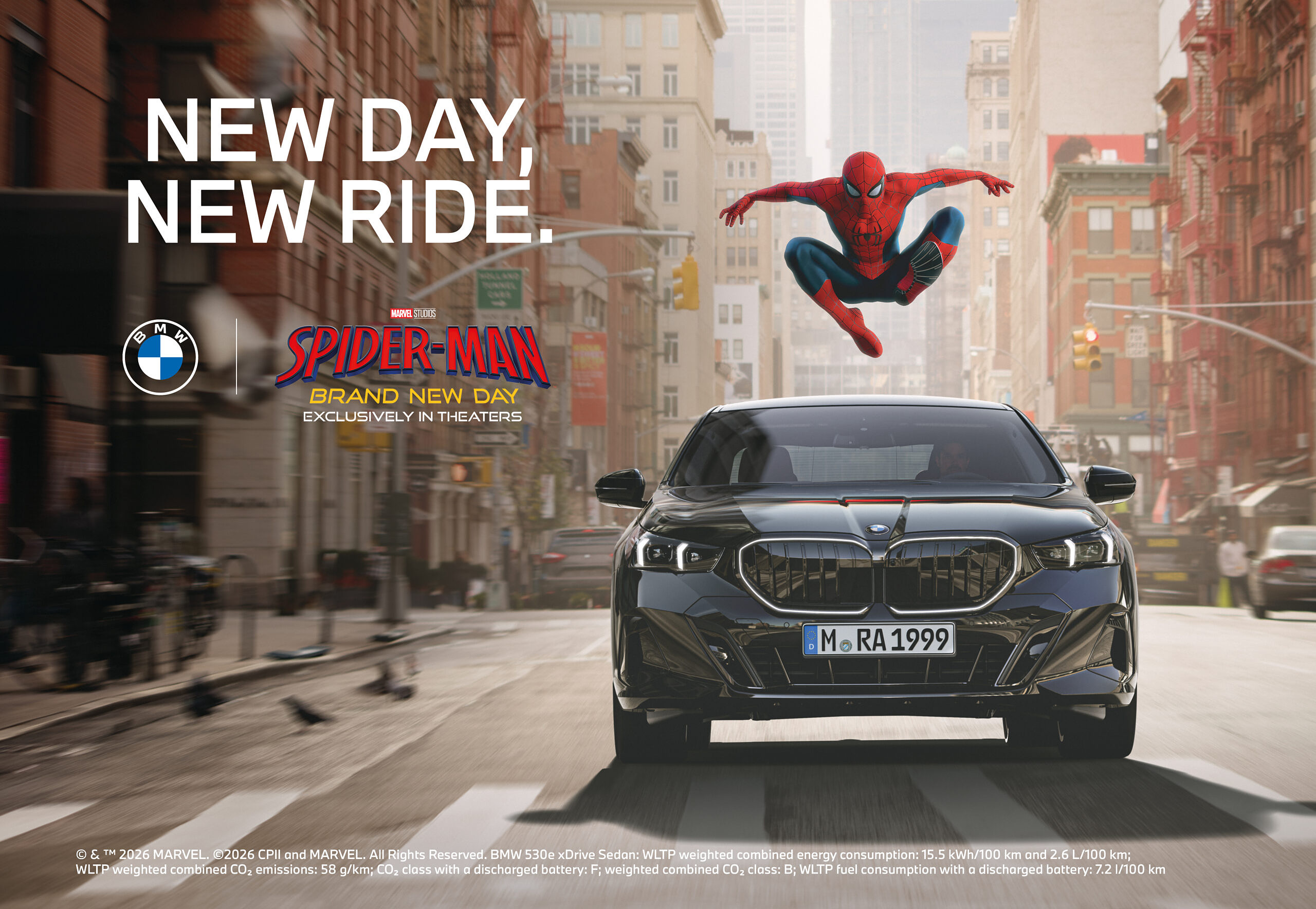
The campaign sparked controversial discussions in the media and forums: Some drivers saw the banner as advertising; BMW considered the animation part of the brand partnership. The debate clearly shows how strongly people react to content on the dashboard.
An opportunity worth 50 billion US dollars: Why the car is becoming an advertising channel
Such campaigns are made possible by connected cars. The vehicles are permanently online and receive over-the-air updates. Technically, brand content is delivered to their screens just like a new version of a map. The infotainment system is therefore much more than just a control element.
The automotive industry sees this as a profitable new business field. For example, Stellantis aims to generate around 20 billion euros annually from software-based services by the end of the decade. The Center of Automotive Management (CAM) predicts that the addressable market for in-car commerce will exceed 50 billion US dollars by 2030 – the equivalent of 100 to 120 US dollars per vehicle annually.
For advertisers, there are three reasons why the dashboard is so exciting:
- Clearly defined moment: The screen reaches people in a precisely identified situation, such as when they are starting the vehicle or at a charging point.
- Relevant context: The location and route enable highly targeted messages.
- A new screen: Hardly any ads have appeared on the dashboard up until now, so brands are competing against fewer other senders on this channel.
What opportunities does in-car advertising offer today?
Automakers and advertising platforms primarily implement three formats on in-vehicle screens: brand experiences, in-car offers, and sponsored content in the navigation system.
Brand experiences: Creating captivating encounters in the vehicle
Automotive companies use the screen to showcase their brand. BMW regularly delivers seasonal animations via the Festive App. The Spider-Man campaign also ran on this channel. Mercedes-Benz uses Graphic Goodies to screen visuals linked to partnerships such as the Masters golf tournament and considers them an experience feature. Formats like these are particularly suitable for co-branding and collaborations with the entertainment industry.
In-car offers: Deals right on the dashboard
In-car offers appear as information in the infotainment system. Stellantis uses the in-vehicle messaging feature in its Uconnect system, for example to display a special promotion such as 1,500 dollars toward a new Jeep. According to the automaker, the system displays such content only when vehicles are stationary. External brands are also taking advantage of in-car offers: Platform operator 4screen reports that parking facilities company APCOA achieved a 39 percent conversion rate from a three-month campaign implemented using its technology.
Sponsored content in the navigation system
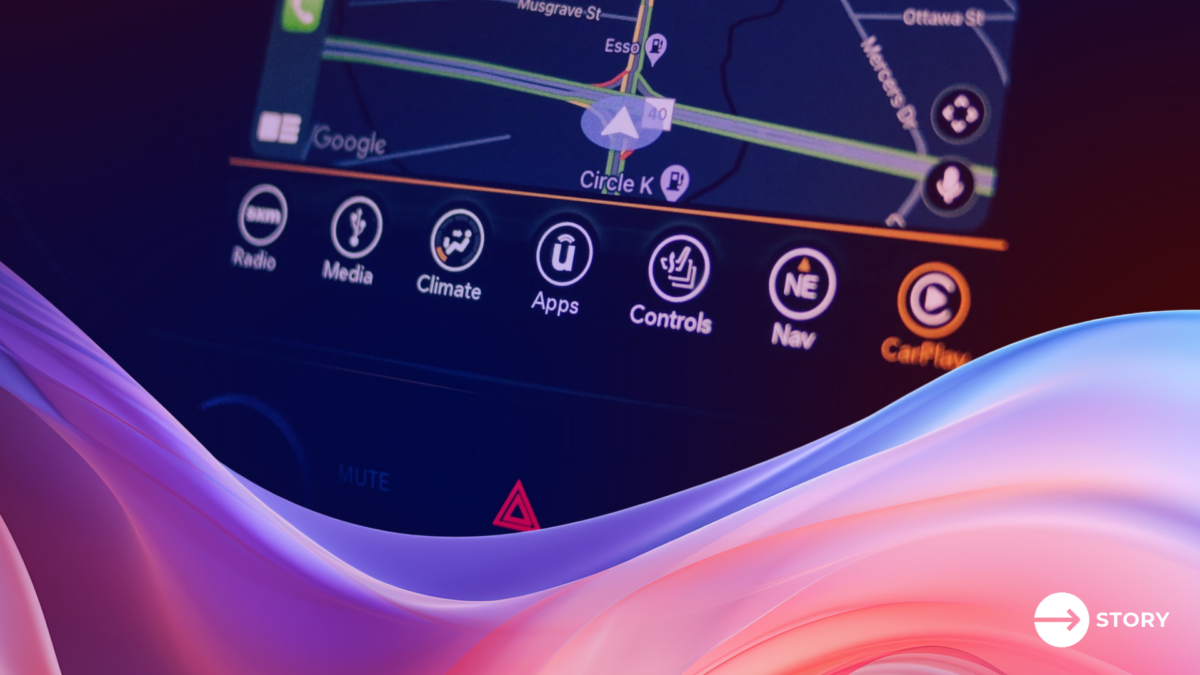
Route guidance applications open up another stage for brands. Platforms such as 4screen collaborate with automotive manufacturers, including Stellantis, Toyota, Volkswagen, and Mercedes-Benz. They position brands such as McDonald’s, Shell, and Waitrose as branded pins and sponsored search results on the map. We explain in depth how advertising in navigation apps works in our story.
In-car ads and DOOH: The dashboard as an extension of campaigns
Digital out-of-home (DOOH) advertising has long reached car drivers: on freeways, at gas stations, and at charging points. Programmatic DOOH placement enables visuals to be displayed in real time depending on the time of day, weather, or location. In-car advertising continues this communication inside the vehicle.
Within the media mix, the dashboard screen takes over where roadside digital billboards end. A visual alongside the freeway catches the driver’s attention; an offer on the dashboard screen guides them to the nearest branch or charging station. Adtech providers position in-car inventory as an extension of DOOH, connected TV, and mobile. 4screen says that it measures impact based on physical visits: If a vehicle parks at the advertised location within three days of the ad screening, it counts as a success.
How digital out-of-home advertising is evolving was one of the topics covered at the DOOH Summit at DMEXCO 2026. Catch up with the sessions in our VOD Library.
How to plan in-car advertising: Guiding questions for marketing teams
Before testing the dashboard as a channel, you should answer these five questions:
- Does the format match the goal? Brand experiences strengthen image; in-car offers and the navigation system are better for prompting visits to a specific destination.
- Is the context right? The best messages are based on the vehicle’s location, route, or use, such as its charge level.
- How will the channel be integrated with DOOH? Cohesive visuals and joint measurement connect the roadside and the dashboard.
- Is driving still safe? Visual formats should be restricted to stationary vehicles and be easy to close.
- Is the content clearly labeled, and has consent been obtained? Transparent formats and an opt-in create acceptance among drivers.
The takeaway: The dashboard is becoming a screen in the media mix
Is the infotainment system emerging as the next advertising platform? The technology is already available: connected cars, software updates, and large screens. And the first formats – from brand experiences to in-car offers – are already running. BMW’s example demonstrates how much attention the channel generates. Integrating the car into your DOOH and omnichannel planning now as a mobile screen means you’ll be able to gather experience while the market is still in its infancy.

The media and marketing graduate worked for television during his studies and has long felt at home in the world of media. Alex is passionate about topics such as retail media, DOOH, payment, audio and TV.