Agency Trends for 2027: Key Insights from DMEXCO 2026
“What are agencies for?” Kristian Meinken, CEO of pilot Group, asked at DMEXCO 2026. The more routine work AI takes over, the more urgent the question becomes. The key agency trends for 2027 reveal where agencies will create value in the future.
Agencies in 2027: Time to move forward, not wait and see
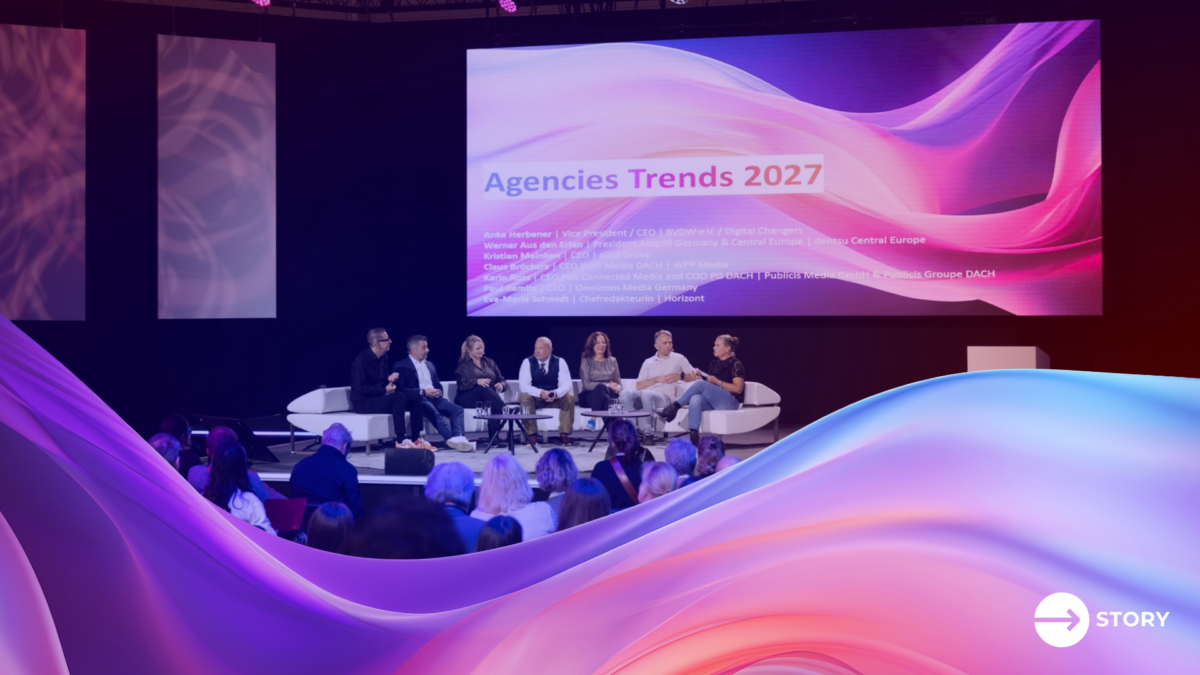
Reinvention is all in a day’s work for agencies. And it’s a skill that’s certainly paying off right now, as AI turns entire areas of business upside down. “Agencies are highly innovative when it comes to redefining themselves, understanding what’s happening in the market, and figuring out how to create value for their clients,” as Anke Herbener, Vice President of the German Association for the Digital Economy (BVDW) and CEO of Digital Changers, noted during the panel discussion “Agency Trends 2027.” Even in today’s tough economic climate, she can see opportunities: “There are also agencies that are really thriving during this crisis.”
The market is providing a tailwind. At DMEXCO, the media agencies within the BVDW presented the “Trend Monitor 2026.” According to the report, 70 percent of media agencies are experiencing strong demand for digital advertising. Last year, that figure was just 40 percent. Growth of 8 percent is expected for 2027. So, the question isn’t whether there’s business available, but rather which agencies will win it.
The most important marketing agency trends
#1 Convergence rather than consolidation
At first glance, the agency landscape appears to be contracting. Paul Remitz, CEO of Omnicom Media Germany, disputes this assessment. While it’s true that media, creative development, and tech are consolidating, Remitz stressed, “It’s actually more a case of convergence. In other words, how do we bring different disciplines together?” Omnicom’s martech division is growing. The group has been investing in data technology for many years. Automation is primarily focused on the “operational engine room,” freeing up time and resources to bring the various disciplines into closer alignment.
Kristian Meinken doesn’t see the pressure to change as a threat, but rather as the very core of the business: “What are agencies for? To respond to changes in the market faster and earlier than client organizations have to.”
Action you can take: Assess which tasks can be automated. Invest the freed-up capacity in data, technology, and cross-disciplinary integration. Make change part of your offering.
#2 From AI-first to AI-native agency
According to the Trend Monitor 2026, AI is firmly embedded in the work routine of nearly two-thirds of media agencies (63 percent). 90 percent of respondents already regard AI expertise as a basic requirement for agencies. As a result, AI isn’t a strong differentiator anymore – not even for companies that position themselves explicitly as AI agencies. Anke Herbener described the next step:
“In the future, success will be measured more by the added value agencies create for their clients, and not just by how quickly results are delivered. AI is evolving from a tool into an integral part of processes, collaboration, and value creation. We’re on a journey from AI first to AI native. Consequently, agencies are increasingly becoming partners driving transformation, innovation, and growth.”
Service portfolios are also changing, with media agencies predicting that AI advertising (94 percent) and GEO/SEO (88 percent) will become more important over the next five years. Only 39 percent expect similar gains for conventional search engine advertising.
Action you can take: Rather than treating AI as an add-on tool, fundamentally realign your processes, collaboration, and service offerings to incorporate it. Offer GEO as a standalone service so that your clients’ brands remain visible even in AI-generated responses.
#3 Measurement – the new nervous system
The Trend Monitor 2026 revealed that media agencies are evolving from operational service providers into strategy consultants. Above all, agencies can distinguish themselves through creativity, demonstrable impact, and the quality of their advice.
In the session “Agency Benchmark: The Agency of the Future,” Nadja Böhme, CEO of Factworks, outlined how this can be achieved. “The agency of the future isn’t a fixed state that can be put into words,” Böhme explained, adding that it requires skills that must be trained like muscles: The first muscle identifies and interprets changes in the market and among clients. The second reacts flexibly and adapts working methods, processes, offerings, and pricing models. “And the nervous system that connects the two is measurement.”
And that’s precisely where your opportunity lies: 69 percent of media agencies say that making data, reach, and impact comparable across channels is one of their biggest challenges. 92 percent believe that consistent approaches to data usage are critical to success. Furthermore, 69 percent expect digital IDs to become established in campaign management.
Action you can take: Test impact-based pricing models instead of just billing by the hour. Don’t just measure the success of your campaigns – also identify where your agency itself needs to make adjustments, whether to processes, services, or pricing models.
#4 Niche trumps generalist
The agency benchmark shows that specialized agencies are better equipped to handle current trends. Nadja Böhme sums it up in three words: “Niche trumps generalist.”
Specialization also changes the nature of collaboration – there’s no longer just one agency business model. Karin Ross, CEO of Publicis Connected Media and COO of Publicis Groupe DACH, observed that there are now a wide variety of configurations. One driving factor is data ownership – as the world becomes more fragmented, data increases in value. Advertisers should therefore ask themselves: “Who actually plays precisely which roles in the overall marketing process?” The answers are often hybrid. However, Ross isn’t aware of any model that involves no consulting or service delivery from an agency at all.
Action you can take: Sharpen up your profile: What does your agency stand for? At an early stage in your relationship with clients, clearly define who owns the data and what role you’ll play in the overall setup.
#5 Gen Alpha: Welcome to hyper-personalization
Topics on the agenda at the NXTGEN Agency Summit included the creator economy and community building. In their lecture titled “Gen Alpha ≠ Gen Z 2.0,” Tabea Schubert (Creative Lead) and Miriam Stroinski (Junior Art Director) from BUTTER. Social explained what distinguishes the next generation from Gen Z. Even more so than Gen Z, Gen Alpha spends time in highly differentiated digital spaces, and it’s hard to find a common platform used by everyone in this group. The speakers’ key takeaway is therefore: “Welcome to hyper-personalization.” When it comes to marketing, this means: “Anyone who persists in trying to reach everyone today will ultimately reach no one, because this approach no longer resonates with anyone.”
Action you can take: Develop creative content and media plans for smaller, clearly defined target audiences. Communities and creators will help you establish the authenticity of your message.
The bottom line on agency trends for 2027: Added value trumps speed
Demand is growing, and AI is giving agencies the freedom to focus on activities that help their clients achieve their goals. Agencies therefore have an opportunity to redefine their value proposition by means of a clear profile and demonstrable impact. This also answers Kristian Meinken’s question: The purpose of agencies is to identify changes affecting their clients earlier and translate them into growth.
Want to learn more about the latest agency trends and additional highlights from DMEXCO 2026? You’ll find a wide range of sessions in the DMEXCO video-on-demand library.