Verena Gründel Met a Cyborg
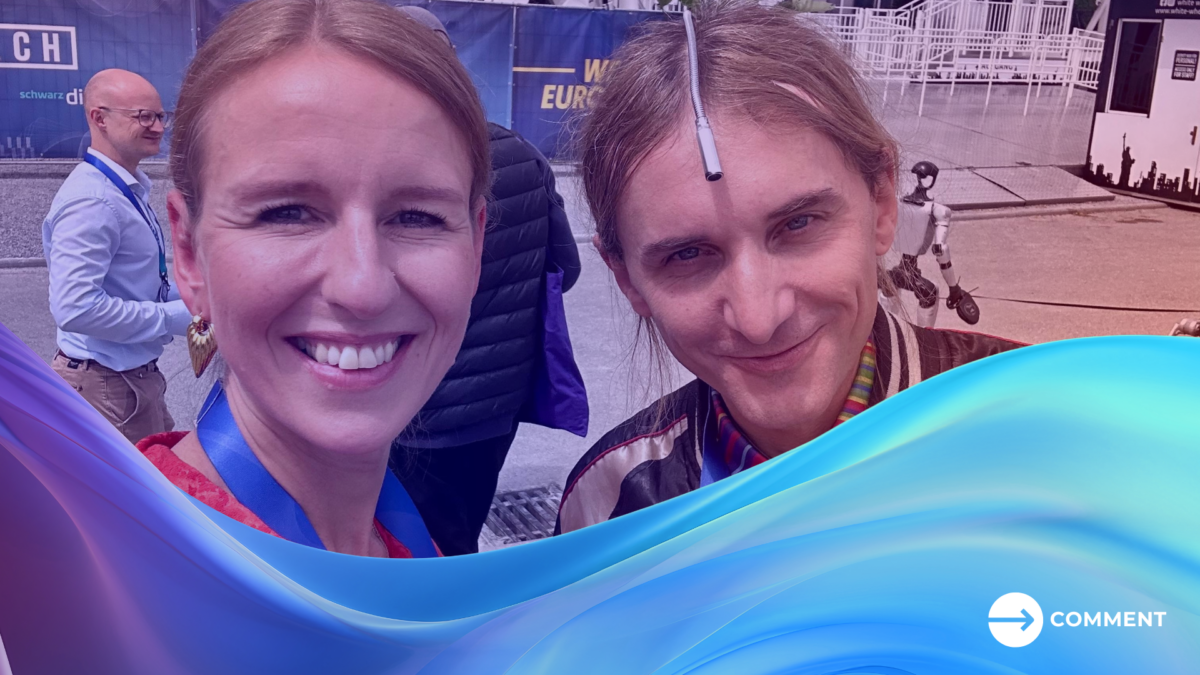
An antenna implanted in his head, new senses, and a radically different way of experiencing the world: At TECH 2026, Verena Gründel meets the world's first officially recognized cyborg and explores how much machine can become part of being human.
Where Does the Human End – and the Machine Begin?
I want to tell you about my meeting with a cyborg. Neil Harbisson is the world’s first legally recognized cyborg.
Neil used to be a normal person. Then he had an antenna implanted in his brain. It gives him abilities that far exceed human capabilities.
Now he can perceive light waves as sensations, such as vibrations. He senses yellow, green, and red—but also infrared and ultraviolet. His favorite color, he says, is ultraviolet. It feels warm and deep.
As a non-cyborg, Neil was colorblind. Now he perceives stimuli from the world that none of us can imagine. So he has expanded his range of perception through technology. With an antenna that was drilled through his skull.
Meanwhile, the human-machine interface feels natural to him, he explains at the TECH 2026 conference in Heilbronn. He reportedly no longer distinguishes between perceptions from his own sensory cells and those from the sensors. To him, the antenna feels like his own organ.
But where is the line? When do human and machine truly merge?
Is our cell phone usage already turning us into “cyborgs-light”? After all, we experience physical withdrawal symptoms when we forget our phone at home. Our heart rate has been shown to rise. We go on high alert and become more nervous. Not only that: we curse that “our” battery is dead, when we actually mean our iPhone’s.
It is a misconception that cyborg enhancements always start with the brain. Intelligent exoskeletons can also be included. And electrodes on the body. Or the implants under the skin that can cure epilepsy.
Human-machine fusions have the greatest chance of success when the benefit to humans outweighs the invasiveness. That’s what Pascal Fries, one of the leading researchers in the field, said at TECH. This is especially true in the medical field, he noted, because patients’ suffering is particularly severe. That’s why most applications have been in this area so far.
Neil Harbisson, on the other hand, also believes that implanted chips will catch on as lifestyle gadgets. He compares them to tattoos, which are now completely normal. For example, implanted chips that allow us to communicate with each other much more easily than via text message. Or so that we, like him, can expand our senses. “Society gets the chance to shape its own perception of reality,” he predicts.
To me, that sounds like a never-ending drug trip. A legal one. And technically much more impressive. But it remains to be seen which is more dangerous.
Don’t miss any important news from the world of digital marketing, both nationally and internationally! Subscribe to the new DMEXCO newsletter “Digital Digest” and receive the latest information directly in your mailbox every Monday, Wednesday, and Friday.