Tech Trends for 2027: Key Insights from DMEXCO 2026
AI is becoming a core part of business infrastructure, AI agents are emerging as the new players in commerce, and data will prove critical to success – at DMEXCO 2026, experts discussed the tech trends set to define 2027. Here are our top five!
Tech in 2027: From experimentation to integration
How can AI move out of the experimental stage and into productive use? What data do AI systems need? What will stores need to look like if future customers will include autonomous AI agents? And which tasks do we actually want to delegate to machines?
These questions brought industry professionals to DMEXCO 2026 in search of answers. Experts on the event’s various stages shared specific experiences, presented potential solutions, and explored the deeper underlying issues.
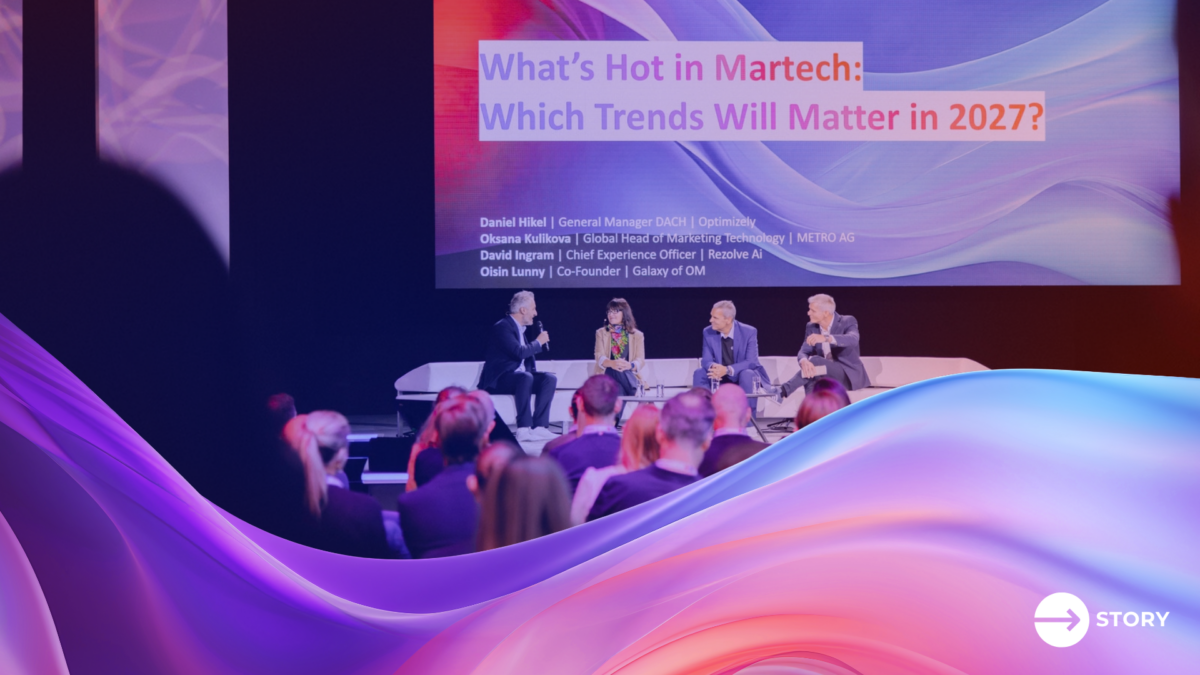
David Ingram, Chief Experience Officer at Rezolve Ai, summed up a key insight during the panel discussion “What’s Hot in Martech: Which Trends Will Matter in 2027?” when he said: “AI is not a trend – it’s a structural change.” Many sessions at DMEXCO 2026 illustrated what that means in concrete terms.
5 tech trends for 2027 you need to know about
#1 Infrastructure is becoming AI-ready
There’s no longer any question of whether companies are using AI. What matters now is how deeply AI is integrated into their systems and processes. Just how far this transformation has already progressed is clear to see in the adtech sector. During the panel discussion “Inside Modern Adtech: How Digital Advertising Actually Works Today,” Senga Powers from Adform pointed out that programmatic advertising without AI has long been unthinkable. What’s new, she noted, is AI’s role: In the past, AI worked “behind the scenes”; today, it works “next to us.”
In other words, AI is evolving from being an invisible component of technology into an active partner in our day-to-day work. In the panel discussion about martech trends in 2027, David Ingram went a step further, saying that companies must fundamentally align their systems and digital offerings with this new reality.
Action you can take: Don’t just ask which AI tools could be useful. Review which processes and systems need to change if AI is going to be a long-term partner.
#2 No AI without data
What is the key to ensuring that AI delivers genuinely good results in a business? The answer may not be particularly earth-shattering, but it is vital: good data. In the masterclass “AI Won’t Save You. Your Data Will. Inside the Backbone of E.ON Deutschland’s Communications,” Manuel Riegel, Senior AI Communications Manager at E.ON, explained what this means in practice. His guiding principle for AI deployment in companies is “No AI without data.”
Working with Scompler, E.ON began by creating a standardized foundation for content planning, workflows, and data. Data products and AI agents can now be built on top of this foundation.
Action you can take: Before you scale your next AI use case, review your data foundation. Is the information up-to-date, structured, and usable by AI systems?
#3 Your next target group might not be human
So far, websites and online stores have primarily been built for people. That could be about to change. During the panel discussion “What’s Hot in Martech: Which Trends Will Matter in 2027?” Oksana Kulikova, Global Head of Marketing Technology at METRO, identified a key challenge for companies: They must orchestrate agentic and generative AI tools just as effectively as they do human search.
In her keynote on the Tech Stage, Lara Sophie Bothur explained why this is important. In her analysis of eight tech-psychology trends, she referred to study results indicating that 32 percent of people would be willing to let AI decide what they buy.
This raises a new question for brands: How do you stay visible when it’s no longer just people but also their AI agents who are searching, comparing, and preparing short lists?
Action you can take: Look at your digital presence from the perspective of an AI system. Can it find your products and services, understand them, and incorporate them into its decisions?
#4 The smarter the AI, the more important human agency becomes
Technological revolutions don’t just change what people can do. They also change how they think, feel, and make decisions. That’s why Lara Sophie Bothur talked about a psychological revolution going hand in hand with every technological revolution.
In her keynote “Dear Future – What Kind of World Are We Building?” she identified eight trends, ranging from emotional outsourcing and synthetic relationships to the trust gap and the authenticity problem. Her “agency paradox” is particularly insightful: 74 percent would delegate routine tasks to an AI agent. At the same time, as technology gains more and more capabilities, it becomes increasingly urgent to ask what we do not want to delegate.
Lara Sophie Bothur’s session offered up a particularly thought-provoking suggestion: As machines process increasing volumes of information, perhaps one of humanity’s strengths lies in making choices, setting boundaries, and following our own intuition.
This also has an exciting implication for brands. If content can be generated and perfected without restriction, human perspective – and even human imperfection – could regain value as signs of authenticity.
Action you can take: Rather than just defining which tasks AI should perform, specify the areas where human judgment, responsibility, and trust remain indispensable.
#5 Payment tech is preparing commerce for AI agents
If AI agents are to not only find products but also complete transactions in the future, the right technological infrastructure will need to be in place. Payment tech has a key role to play in this.
In her session “Payments: The Invisible Infrastructure Behind Intelligent Ecommerce,” Carola Wahl from PayPal demonstrated the extent of the changes already happening in the payment space. Payment is no longer just the final step in the checkout process. Embedded payments are increasingly integrating financial processes seamlessly into the commerce ecosystem. Ideally, customers are barely even aware of the payment process as a separate step. At the same time, the technology can support conversion, cash flow, and more efficient workflows behind the scenes.
With agentic commerce, this development takes on a new dimension. In a world where it’s no longer just people making purchases, payment infrastructure must also be capable of handling machine-initiated transactions. That’s why David Ingram identified functional ecommerce platforms for agents and digital-first payments as key prerequisites for the next generation of commerce.
These changes will reach beyond checkout itself. Closer integration of search, product selection, purchase, and payment will be possible – and, in some cases, these steps will be handled by agents. The finalists in the “Young Innovator Challenge 2026” also focused on solutions that would merge discovery and conversion: One team combined Snapchat with NeoTaste for Coca-Cola, while the other developed a personalized digital product selection process for Rituals. These concepts show how payment tech is becoming part of the infrastructure that makes seamless, increasingly automated commerce possible in the first place.
Action you can take: Don’t treat payment as something that only happens at the end of the checkout process. Find out whether your payment and commerce infrastructure will still work when AI agents start performing parts of the purchasing process.
The takeaway: Tech trends for 2027 – AI is becoming a core part of business infrastructure
The experts at DMEXCO addressed many of the questions currently facing the digital economy as we look ahead to 2027. The sessions explored what infrastructure AI requires, why AI data quality is fundamental, how digital products and services are evolving to suit AI agents, why the human perspective remains important, and what role payment tech will play in agentic commerce.
Would you like to dive deeper into the tech trends for 2027 and hear the experts’ insights and thought-provoking remarks for yourself? You’ll find the panel discussions, masterclasses, and many other sessions in the DMEXCO video-on-demand library.
Don’t miss any important news from the world of digital marketing, both nationally and internationally! Subscribe to the new DMEXCO newsletter “Digital Digest” and receive the latest information directly in your mailbox every Monday, Wednesday, and Friday.


In his texts, he mainly focuses on current developments and challenges in e-commerce.